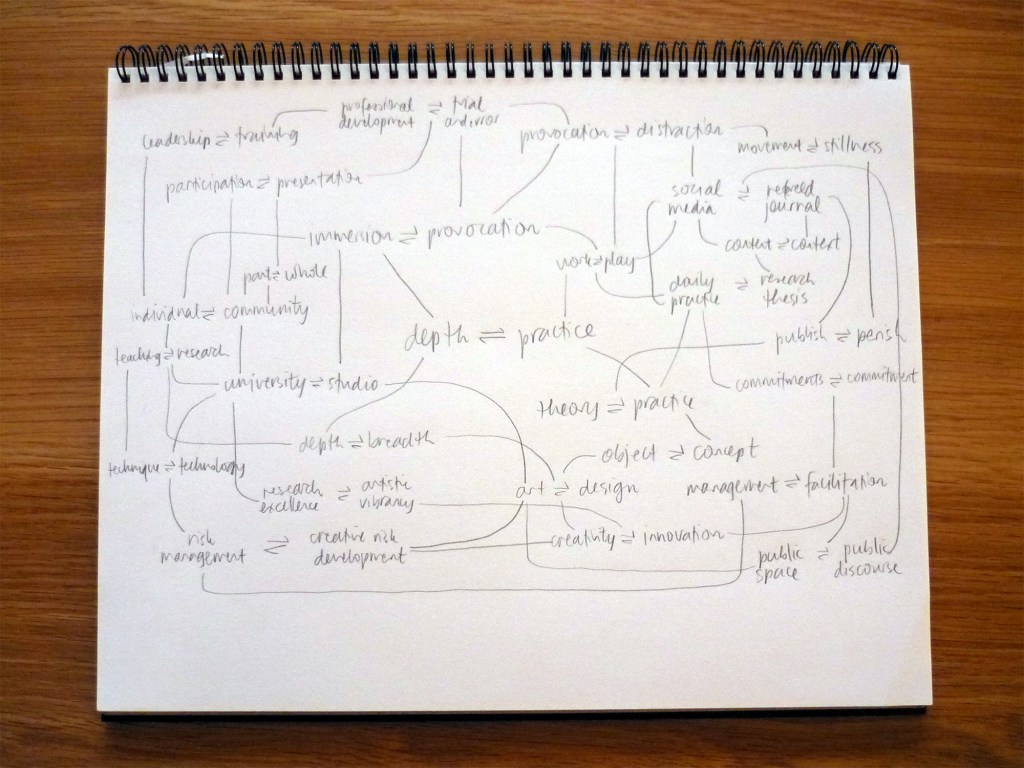
Deep Practice is that rare state of productive flow that the artefacts, methodologies and processes of artistic practice seek.
How do you prepare for deep practice? I immerse myself in a space that is tantalisingly intricate in form and content, taking agile steps from the one to the other. I approach the challenge before me by mind-mapping trajectories through a field of tensions, drawing new connections and provoking new tensions logically, linguistically, creatively. I grasp for the structure that will set my thinking free; only an approach “that rigidly excludes the usual way of relating the parts of a proposition could achieve the goal of plasticity.”[1] This is a highly individual experience, and clearly a personal delight – and yet it’s not unfamiliar to you. You relate it warmly to your own highly idiosyncratic mode of writing and diagramming. You crave that reconciliation between your deep creative space, and the structures and requirements of your everyday practice. If I am to immerse alone, I have no need of a framework – “Ah, but only one is a wanderer. Two together are always going somewhere.”[2] The moment we wish to collaborate, we are compelled to map common ground, create sets of rules, design flexible structures. We must create our own conditions as we go; we must experience the tensions and grapple with what is at stake; we must plan unintended consequences. For two days we will navigate surface and depth with increasing alacrity, now emerging with bold treasures, now proclaiming the discovery of new species, now decrying the system and evoking the other. Our dialectical movement is a complex one. It is spatial: it describes a work place, a creative context, a physical environment. It is cultural: it makes value judgements, it prioritises sets of practices above others, it requires a language. It is political: it undoes fixed hierarchies, it questions existing work modes, it challenges economies and systems. In coming together, we affirm our commitment to the deep practice we will engage in together. We seek a space where deep practice can be conceptualised, and we make a space where deep practice can be achieved. “This is how space begins, with words only, signs traced on the blank page.”[3]
Esther Anatolitis was a facilitator at RMIT’s 2011 Deep Practice: Deepening knowledge and innovation through design practice.
[1] Hegel, G W F. Phenomenology of Spirit (1807), trans. A. V. Miller, Oxford University Press 1977; §64
[2] Vertigo (1958). Director: Alfred Hitchcock. Screenplay: Alec Coppel, Samuel A. Taylor.
[3] Perec, G. Species of Spaces and Other Pieces (1974), trans. John Sturrock, Penguin 1999; p.13
