2004
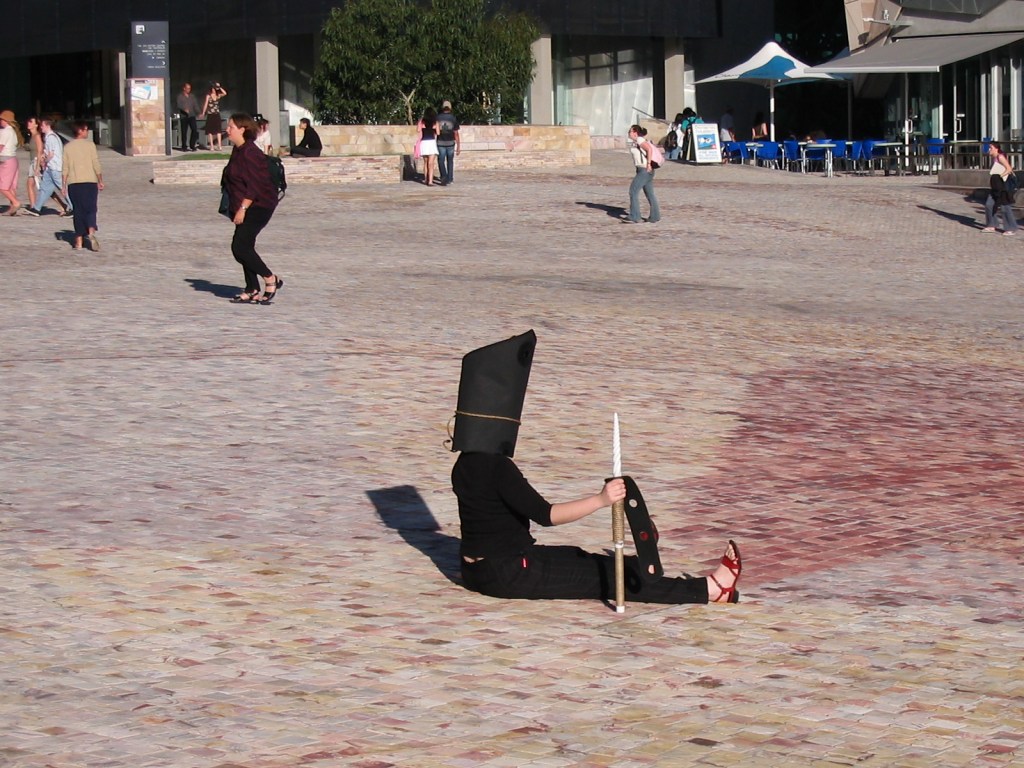
Like public art, philosophy offers the passer-by an encounter which can give rise to a new approach, a newly productive perspective. Each of the workshops in this series brings philosophers into a productive exchange with an artist, an exchange which produces a design for a work of public art.
The first session sets the scene: introducing participants, discovering shared concerns, and determining the limits of our cross-disciplinarity. I present some past work for context, and then we negotiate an agreed method. Philosophical issues current to the urban-political sphere are considered (e.g. asylum, citizenship, translation, security, multiculturalism, terrorism, democracy, communication, the other, power). Participants are challenged kinæsthetically as well as philosophically: how might we provoke further engagement on this issue through public art (e.g. video projection, digitally enhanced space, broadcast, sculpture, installation)?
Why public art? Because it’s encountered without having to enter a designated art space – and it’s designed to be disruptive as well as engaging. Public art is introduced in contrast to advertising: that urban phenomenon designed to imprint the passing consumer with compelling criteria for action. Advertising dominates the urban visual landscape, impacting daily on our moral, æsthetic and intellectual conscience. Yet while advertising is widely accepted as an urban inevitability, public art is often the target of scathing criticism – and philosophy has little place at all in these contexts. Using the city as an interface, in what way can we as philosophers pose virulent questions which don’t remain with the passer-by but are spread through the street, the office, the tram, the home? Importantly, the workshops also address the question: What kind of city do we want to live in?
The philosophy as public art series does not merely introduce some critical focus points to an urban landscape littered with advertising images and “Safe City” surveillance cameras. It also seeks to redetermine philosophy as a public art.
Facilitated by Esther Anatolitis
First presented in 2004 as a 5x2h workshop for 20 participants with a guest artist each day across a week at Ross House, 251 Flinders La Melbourne, and surrounding streets.
